Twenty years ago the path to a customer was easy to draw. Someone typed a question into Google, got a list of blue links and clicked one of the top results. Search engine optimisation, SEO, was about climbing as high up that list as possible, because that was where the traffic was.
That list is still there. But today the same question can get a finished answer instead. Someone asks ChatGPT “which is a good hairdresser in Uppsala?”, writes to Perplexity “who repairs stone chips in Hägersten?” or reads Google’s AI Overview in the search results. In all three cases the result is an answer, not a list. An answer that mentions certain businesses and says nothing about others.

If your business isn’t mentioned where it should be, you may have lost a customer you’ll never find out you lost. That is what GEO is about preventing.
This article explains what the term means, what it isn’t and how AI services choose their sources. How to do the work step by step is covered in AI SEO in practice.
What does GEO mean?
GEO stands for Generative Engine Optimization. Generative here means that the answer is written by a language model, instead of you getting a list of links. Where SEO is about ranking in the list, GEO is about becoming one of the sources the written answer is built on when someone asks about what your business does.
The term was introduced in a research paper. “GEO: Generative Engine Optimization” by Pranjal Aggarwal and five co-authors was first published on arXiv on 16 November 2023 and accepted to the KDD 2024 research conference. The researchers grouped search engines that use language models to summarise information from multiple sources under the name generative engines, and GEO became the name for the work of making content visible in their answers.
You will also come across GEO optimisation. It means the same thing, even though the O in GEO already stands for optimization.
What GEO is not
The word is short and used for several things, so here are three clarifications.
It is not geographic marketing. In marketing, geo often means something geographic: geomarketing, geotargeting and geofencing, that is, aiming ads or content at people based on where they are. GEO in AI search has nothing to do with that. Local visibility, being found when someone searches for what you do where you are, is related but a separate question. We cover it in How to become more visible on Google in your city.
It is not a trick. GEO is not a set of tricks that fools a language model. Google writes in its guide to generative AI features in Search (updated 10 July 2026) that many suggested “hacks” aren’t effective or supported by how Google Search actually works, and that seeking inauthentic mentions across the web isn’t as helpful as it might seem. Our assessment is that the same applies to the other AI services: they can’t be gamed in the same way old search engines could be with keyword stuffing and bought links. What carries the weight is clear, accurate and consistent information about the business.
It does not replace SEO. Google writes that, from Google Search’s perspective, optimising for generative AI search is still SEO. The best practices for SEO continue to be relevant, because its AI features in Search are rooted in its core ranking and quality systems. How the two approaches differ is covered in GEO vs SEO.
GEO, AEO, LLMO and AI SEO: what’s the difference?
The same work goes by several names. Google itself mentions AEO and GEO as terms you may come across for work focused on visibility in AI search.
| Term | Written out | How the word is usually used |
|---|---|---|
| GEO | Generative Engine Optimization | Becoming a source in answers written by AI. Introduced in the 2023 research paper. |
| GEO optimisation | – | The same as GEO, with the optimisation spelled out twice. |
| AEO | Answer Engine Optimization | The same work. Also used for featured snippets and voice search, where the answer is shown directly. |
| LLMO | Large Language Model Optimization | Optimising for large language models. The same work under another name. |
| AI SEO | – | An everyday umbrella name. Can also mean using AI tools in SEO work. |
| Generative AI features | Google’s own wording | Google’s name for the AI features in Search, such as AI Overviews and AI Mode. |
We haven’t found any standard that separates the terms; in practice they refer to the same work. The name that needs a second thought is AI SEO, because it can mean two different things: appearing in AI answers, which is what this article is about, or using AI tools in ordinary SEO work. We explain both meanings in AI SEO in practice.
How does an AI choose which sources to use?
Put simply, an AI service has two ways of knowing something about your business.
Training data. The language model has been trained on large amounts of text, including text from the web. What it knows about a business depends on what had been written about it, and how clearly, when that text was collected.
Sources fetched while the answer is written. Many answers also draw on pages the service searches for while it writes the answer. The technique is called retrieval-augmented generation (RAG), or grounding. This is how the services describe it themselves, as of October 2026:
- Google’s AI Overviews and AI Mode are rooted in Google’s core ranking and quality systems. They may use a technique called query fan-out, issuing several related searches across subtopics and data sources, to develop the answer. To be eligible as a link in the answer, a page must be indexed and eligible to be shown in Google Search with a snippet.
- ChatGPT may search the web automatically when a question would benefit from current information, and users can also choose search themselves.
- Perplexity searches the web in real time when it answers, and Claude can search the web when a topic benefits from current information.
The services don’t all fetch from the same place; they use partly different crawlers and search indexes.
Whichever route, we see the same tendencies: sources that are clear, named and consistent with other sources are preferred, and fresh information weighs more when the question concerns things like prices, opening hours or range. That is our assessment, and these are patterns rather than rules. But they are stable enough to work towards.
In short, that sets three requirements for a source: it must be fetchable, understandable and consistent with other sources. How to meet them step by step, including which crawlers your site needs to let in, is covered in AI SEO in practice.
Where do generative answers appear?
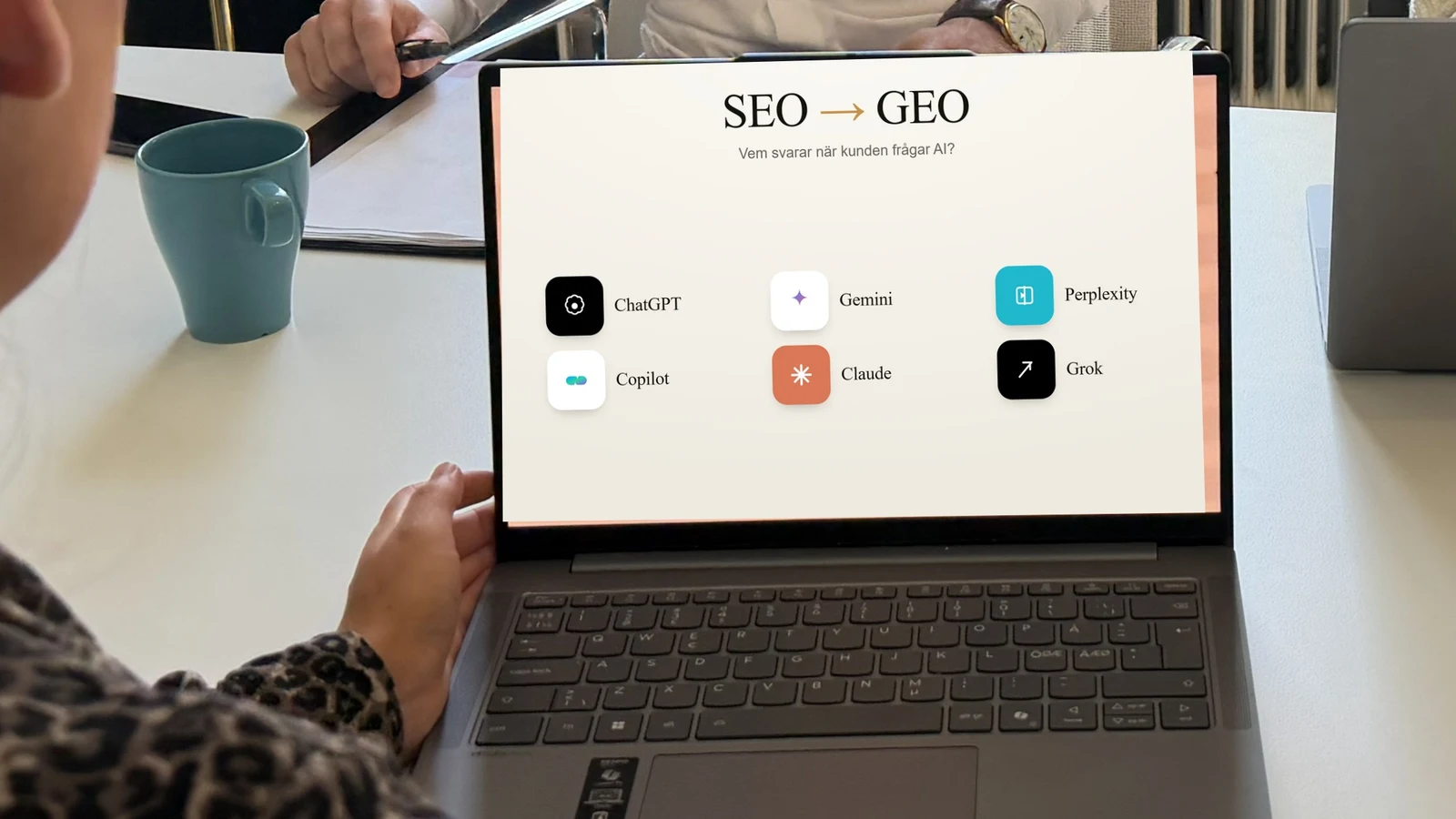
GEO applies to every service that writes answers instead of only showing links. These are the ones we follow, as of October 2026:
- ChatGPT writes its answers in the chat, and answers that use a web search may include citations. More in How your business shows up in ChatGPT.
- Perplexity shows numbered citations in every answer, so you can see which pages were cited. More in Optimise for Perplexity.
- Google’s AI Overviews and AI Mode. AI Overviews appear in the search results when Google’s systems determine that generative AI can be especially helpful, so not on every search. AI Mode extends what AI Overviews can do with more advanced reasoning, for example when you want to compare options. Google lists Swedish and Sweden among the languages and countries where AI Mode is available (checked 17 October 2026). More in Google AI Overviews.
- Gemini, Google’s AI assistant, shows a Sources button when a response has sources.
- Claude, Anthropic’s assistant, cites its sources in answers where it has searched the web.
- Copilot from Microsoft: Copilot Search in Bing, which Microsoft introduced in April 2025, shows a list of the links its answer was built on.
From concept to work
What we call AI visibility is this work in practice: making the business understandable, consistent and easy to cite, wherever the question is asked. The steps, how long it takes, how to measure it and what it costs are in AI SEO in practice.
Frequently asked questions
What does GEO mean?
GEO stands for Generative Engine Optimization. It is the work of making a business or a page a source that AI answers build on, such as the answers in ChatGPT, Perplexity and Google’s AI Overviews.
What is GEO optimisation?
GEO optimisation is the same thing as GEO: the work of being mentioned and cited in answers written by AI. The wording says the same thing twice, since the O in GEO already stands for optimization, but you will come across it.
Is GEO the same as geographic marketing?
No. Geomarketing, geotargeting and geofencing are about aiming ads or content at people based on where they are. GEO in AI search is about becoming a source in the answers AI services write.
Are GEO, AEO and AI SEO the same thing?
In practice they refer to the same work: appearing in answers written by AI. AI SEO can also mean using AI tools in SEO work, and we explain both meanings in AI SEO in practice.
Where does the term GEO come from?
It was introduced in the research paper “GEO: Generative Engine Optimization” by Pranjal Aggarwal and five co-authors. The paper was first published on arXiv in November 2023 and accepted to the KDD 2024 research conference.
Is GEO only about ChatGPT?
No. It applies to every service that writes answers instead of only showing links, such as Google’s AI Overviews and AI Mode, Perplexity, Gemini, Claude and Copilot. The foundation is the same, but the services fetch their sources in partly different ways.
Sources
All web pages read on 17 October 2026. The details about the AI services reflect the situation in October 2026 and may change.
- The research: Pranjal Aggarwal et al., GEO: Generative Engine Optimization, arXiv 2311.09735, first version 16 November 2023, accepted to KDD 2024
- Google
- AI features and your website, Google Search Central, updated 10 December 2025
- Optimizing your website for generative AI features on Google Search, Google Search Central, updated 10 July 2026
- Find information in faster & easier ways with AI Overviews in Google Search, Google Search Help
- Get AI-powered responses with AI Mode in Google Search, Google Search Help, the list of languages and countries
- View related sources from Gemini Apps, Gemini Apps Help
- OpenAI: Searching the web with ChatGPT, OpenAI Help Center
- Perplexity: How does Perplexity work?, Perplexity Help Center
- Anthropic: Enable and use web search, Claude Help Center
- Microsoft: Introducing Copilot Search in Bing, Microsoft Bing Blogs, 4 April 2025